cognita suite · cognita dev + cognita grc

AI drafts. People decide. Auditors verify.

Two self-hosted platforms for regulated technology teams. cognita dev takes every IT change from IT Committee approval to post-implementation review through seven gates. cognita grc runs audits, assessments, controls and inventories in one audited workspace.

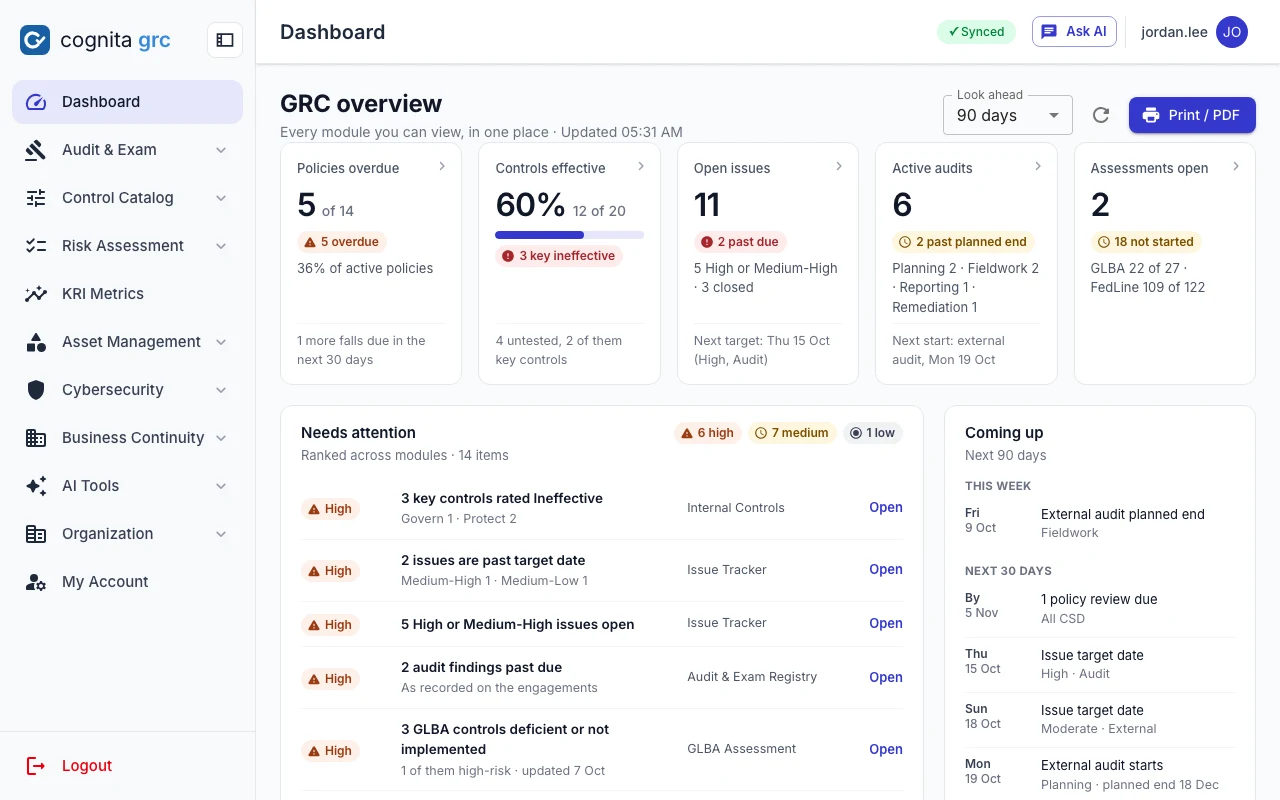
cognita grc · /
cognita grc overview with headline tiles, a ranked needs-attention queue and upcoming deadlines
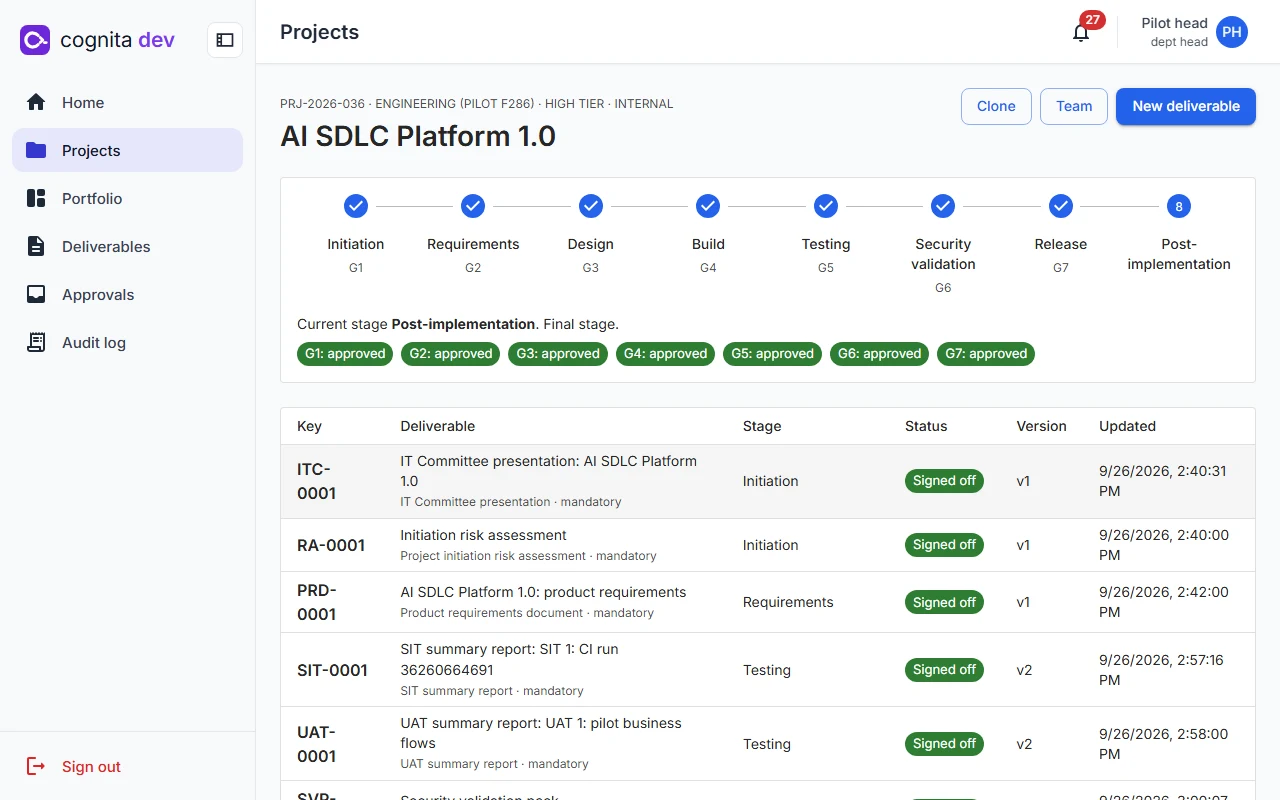
cognita dev · /projects/PRJ-2026-036
cognita dev project workspace with all seven gates approved and every deliverable signed off
Two products, one family

Delivery and governance, built on the same foundations.

Each product stands on its own and runs on your own infrastructure. Together they cover how change is made and how risk is governed, with one interface, one security model and one way of working with AI.

cognita dev

The software lifecycle, gated and on the record.

AI drafts each SDLC deliverable from the project's own records. People review, approve and sign off with an electronic signature. The traceability matrix, readiness checks and gate rules are computed, and auditors get an evidence pack they can verify offline.

  • 10 deliverable types
  • Maker-checker sign-off
  • Live RTM
  • Data flow diagrams
  • SIT and UAT
  • 6 security assessments
  • Evidence pack
Explore cognita dev
cognita grc

Governance, risk and compliance in one audited workspace.

Audits and exams, issues and regulator responses. Control and policy catalogues. GLBA, FedLine and security assessments. Monthly risk indicators. Asset, identity and data-flow inventories. Business impact analysis and incident response plans. About thirty AI actions draft, score and review the work, and your people sign in with Active Directory, SAML or OpenID Connect.

  • Audit & exam registry
  • Regulator response
  • GLBA · FedLine
  • Monthly KRIs
  • Privilege review
  • Data flows
  • BIA · Incident response plans
  • Single sign-on
Explore cognita grc
How the suite fits together

One way of working, from the change request to the exam.

cognita dev governs how software changes are delivered. cognita grc governs the controls, risks and obligations those changes live under. Underneath, both run on the same stack and the same rules.

Delivery

  • Intake and approvalIT Committee deck and initiation risk assessment, signed off at G1.
  • Requirements to designPRD requirements become records; the RTM and the data flow diagram follow them.
  • Test and validateSIT and UAT cycles, six security assessments, findings and risk acceptances.
  • Release and reviewComputed go/no-go checks at G7, then the post-implementation review.

Shared foundations

  • One interfaceThe same shell, navigation and components, so people move between products without retraining.
  • One security modelCookie-only sessions, TOTP multi-factor authentication, authorization enforced on every route.
  • One AI policyEvery model call passes one server-side gateway with an allowlist and an off switch.
  • One stackFastAPI, PostgreSQL, Redis, React and MUI, deployed with Docker Compose on your hosts.

Governance

  • Audit and examEngagement registry, issue tracker, regulator responses grounded in your evidence.
  • Controls and policiesInternal controls, policy inventory, gap analysis against NIST CSF 2.0 and the OCC work program.
  • AssessmentsGLBA, FedLine, information security, data movement and tool assessments.
  • Inventories and continuityIT assets, applications, identities with privilege reviews, data flows and business continuity plans.

The products run independently: deploy one or both. They share design, security model and technology, not a database.

AI with the controls regulators ask about

Fast drafts. Human decisions. A record of both.

AI in the suite writes first drafts, reviews work and proposes links. It never submits, approves, signs off or changes a record on its own, and every call is governed and logged.

  • People decide

    In cognita dev, AI drafts land as new versions labelled AI-generated until a person edits them; only people submit, approve and sign. In cognita grc, AI results stay drafts until an editor saves them.

  • One gateway, one switch

    Every model call goes through a single server-side point. cognita dev adds an allowlist by role and data classification, token budgets and an emergency stop; cognita grc has a platform-wide kill switch that covers every AI action.

  • Your choice of model

    cognita dev works with Claude, Gemini or a model served on your own GPU with vLLM, and only the on-premises model may see Restricted data. cognita grc works with Gemini or the same kind of on-premises vLLM model, so prompts can stay on your hardware.

  • Provenance on file

    cognita dev records the model, prompt version, input hashes, tokens and cost of every call. Regulator responses in cognita grc cite only identifiers found in your evidence, and a QA pass flags any citation that does not check out.

What an auditor sees

A trail that shows its own tampering.

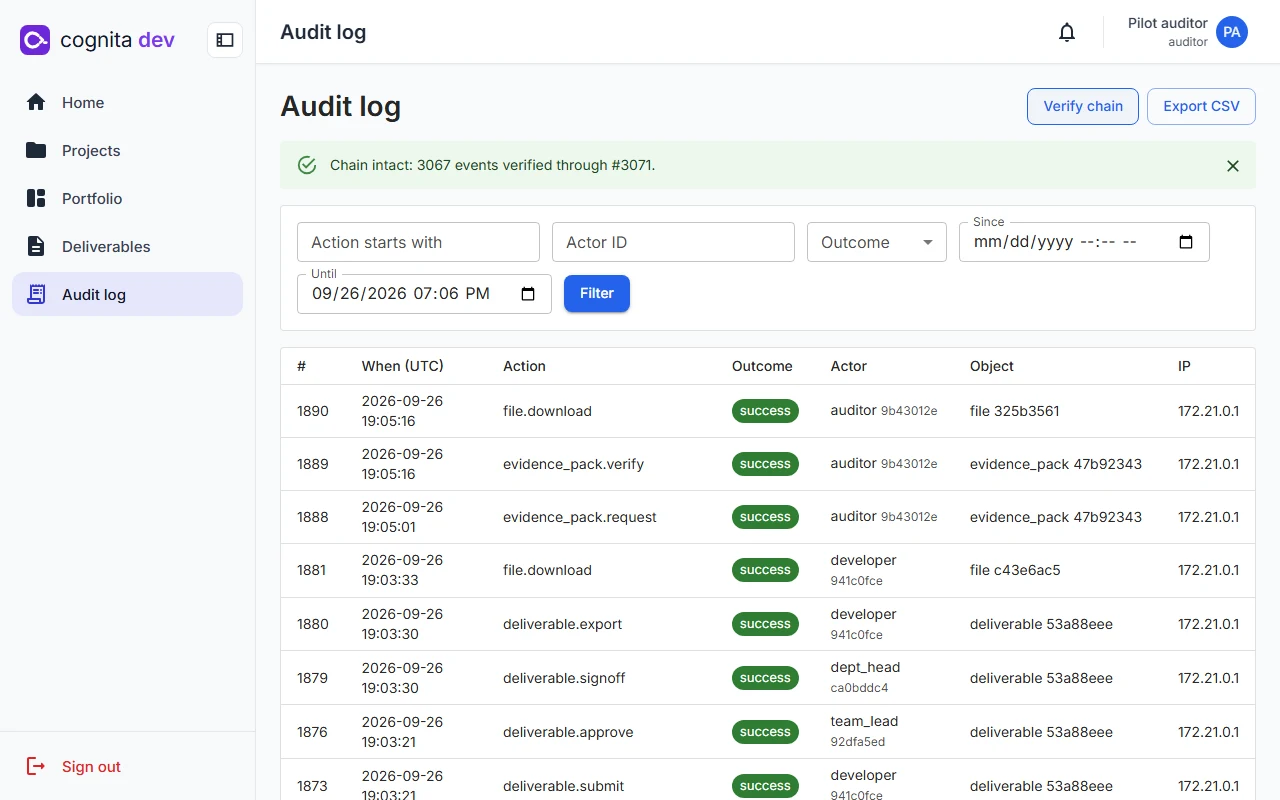
Each audit event in cognita dev stores the hash of the one before it. Change any row and verification fails from that row on. The table refuses updates and deletes, and the application's database role can only insert and read it.

cognita dev · /audit
Audit log listing submit, approve and sign-off events by different roles, with the chain verified
Submit, approve and sign-off come from three different people. "Verify chain" recomputed every link.
  1. #1873deliverable.submit · developerprev … · hash = SHA-256(prev + event)
  2. #1876deliverable.approve · team leadprev = hash of #1873
  3. #1879deliverable.signoff · department headprev = hash of #1876
  4. #1888evidence_pack.request · auditorprev = hash of the event before

Auditors export an evidence pack per project: every signed-off deliverable, the RTM and its baselines, test evidence, security reports, approvals with their meaning statements, and the project's audit rows. A manifest lists each file's SHA-256, and a standard-library script verifies it offline.

How evidence is protected
Who it is for

Built around the roles that already exist in a regulated bank.

TeamWorks inWhat they get
Developers and team leadscognita devDeliverables drafted from project records, test cases generated from requirements, a clear list of what each gate still needs.
Department headscognita devFinal sign-off, gate decisions and risk acceptances, and a portfolio of every project in their department.
IT risk and compliancecognita grcControls, policies, KRIs and regulatory assessments with derived ratings instead of hand-built workbooks.
Information security and identityBothSecurity validation gates in delivery; privilege reviews, data-flow controls and tool assessments in governance.
Audit and exam liaisonBothA read-only auditor role, searchable audit logs, evidence packs and regulator responses grounded in evidence.
Under the hood

Self-hosted, security first, tested at every merge.

Both products run as Docker Compose stacks on your own hosts. Only the web proxy is published; the API, database and cache stay on internal networks.

Identity

Cookie-only sessions and TOTP

No token ever appears in a response body. Failed sign-ins look identical whatever the reason, and accounts lock after repeated failures.

Authorization

Protected by default

Every router except sign-in sits behind a session check, so a new route cannot ship unauthenticated. A test walks every route to prove it.

Operations

Backups you have restored

cognita dev encrypts backups, archives the write-ahead log hourly and runs a restore drill in CI. cognita grc takes scheduled snapshots with a verified manifest.

Questions

Frequently asked

Is cognita suite a cloud service?

No. Both products are installed on infrastructure you control and run as Docker Compose stacks. Your records stay in your PostgreSQL database; the only outbound traffic is to the AI provider you enable, and cognita dev can run with no outbound traffic at all using an on-premises model.

Do I need both products?

No. cognita dev and cognita grc are independent applications. They share an interface, a security model and a technology stack, so running both is easier than running two unrelated tools, but either works alone.

Which AI models are supported, and can we turn AI off?

cognita dev supports Anthropic Claude, Google Gemini and an on-premises model served with vLLM, plus a deterministic mock for testing. cognita grc supports Google Gemini and an on-premises model served with vLLM. In both, an administrator can switch AI off for everyone, and the rest of the product keeps working.

Can AI approve something or change a record by itself?

No. In cognita dev, AI cannot submit, approve or sign off, and its drafts are labelled until a person edits them. In cognita grc, AI output is a draft until someone with edit rights saves it.

Which frameworks does cognita grc cover out of the box?

The GLBA information security program (Interagency Guidelines and Regulation P, with NIST CSF 2.0 and NIST 800-53 mappings), the Federal Reserve FedLine Monitoring and Control Guidelines v3.1, and policy gap analysis against NIST CSF 2.0 or the OCC Cybersecurity Supervision Work Program.

Can our people sign in with the corporate directory?

In cognita grc, yes: register your Active Directory (LDAP), a SAML 2.0 identity provider or an OpenID Connect provider such as Microsoft Entra ID in Administration, and accounts are created on first sign-in with roles taken from directory groups. Local accounts with an authenticator remain for break-glass access. cognita dev uses local accounts with mandatory TOTP.

How do auditors and examiners get evidence?

Both products have a read-only auditor role. cognita dev builds a per-project evidence pack with a SHA-256 manifest that can be verified offline, and its audit log is hash-chained. cognita grc keeps a searchable audit log with CSV export and produces PDF, Word and Excel reports in the shape reviewers expect.

Does it support single sign-on?

Not in the current release. Both products use local accounts created by an administrator, with TOTP multi-factor authentication. There is no self-registration.

See it with your own process

Walk through a change and an exam request, end to end.

We will show a project moving through the gates in cognita dev and a regulator request answered in cognita grc, then talk through deployment on your infrastructure.

Product screenshots on this site show demonstration data.